

Raghuram Palaniappan
If your business sells a sports service within schools (especially Amazing Athletes or Super Soccer Stars), you most likely have a tough time marketing to busy parents. In this article, we go through why partnership marketing with revenue sharing is a good solution to this problem and how to properly structure it so your business does not lose money.
Revenue sharing aligns the interest of all parties involved promoting collaboration. By partnering with schools, your business can reach parents through the school's marketing channels and facilities. The school in return gets back a proportion of the revenue they helped generate.
Key Terms
- Revenue Share (r)
- A percentage of revenue paid to a partner in exchange for some goods/service in return.
- Gross Profit
- Revenue minus the direct costs of goods/services.
- Customer Acquisition Cost (CAC)
- The cost of acquiring a new customer.
- Customer Lifetime Value (LTV)
- The gross profit a business generates from a customer throughout their entire relationship.
- Gross Profit Multiplier (m)
- The desired ratio of gross profit to revenue share payment. A minimum of 3× (300% return) is recommended.
Hypothetical Case Study
Variables:
- x = Participants in class
- p = Price per participant
- l = Labor cost per class
- r = Revenue share rate
- m = Desired gross profit multiplier over rev share
Notes: Labor cost is the money paid to a coach per class. The classes will be limited to 12 participants in these examples. California regulation requires a 1:12 teacher-to-child ratio for preschools. Cal. Code Regs. Tit. 22, § 101216.3.
Current Situation: VolleyInstinct runs one class a week at X school with the following metrics.
x = 12 participants, p = $25 per participant, l = $40 per class, r = 0% revenue share
- Class Revenue = 12 × $25 = $300
- Class Cost = $40
- Class Gross Profit = $260
Proposal: VolleyInstinct offers X school a 20% revenue share on the condition that they fill at least one extra class — for two classes per week with 12 students each.
x = 12 participants, p = $25 per participant, l = $40 per class, r = 20% revenue share
- Class Revenue = 2 × (12 × $25) = $600
- Class Cost = (2 × $40) + $120 = $200
- Class Gross Profit = $400
Result
Sports businesses in this space have trouble selling and reaching parents. To offset this, VolleyInstinct offers the school revenue share to bring more customers. Essentially, the business paid $120 in customer acquisition costs (CAC) to receive $400 in gross profit (LTV).
The mindset shift is that revenue share is payment for receiving customers. Rather than spend money and time marketing towards parents, businesses pay the school directly for the amount of customers they bring.
Why this matters:
- Capital constraints are removed because every dollar spent clearly gives a calculated outsized return. Think of it like investing in a stock that guarantees a 350% return in this example — it's a no brainer.
- The extra profit can be reinvested to scale the business, cover admin costs, cover the initial cost of acquiring the partner, or reward stakeholders.
How do we calculate the revenue share so our business doesn't lose money?
The general rule of thumb is to have customer lifetime value at least 3× customer acquisition cost. So for our case, we want m = 3 for a minimum 300% return on our revenue share payment.
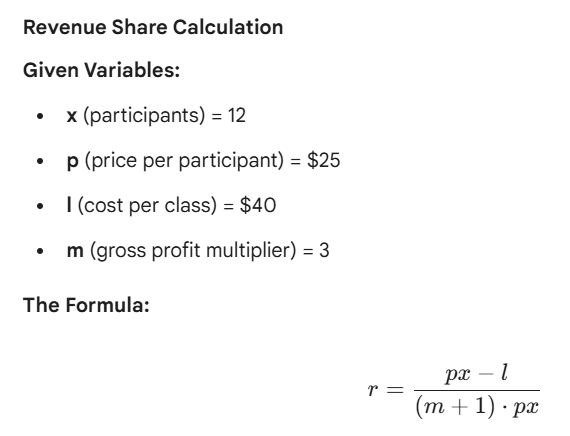
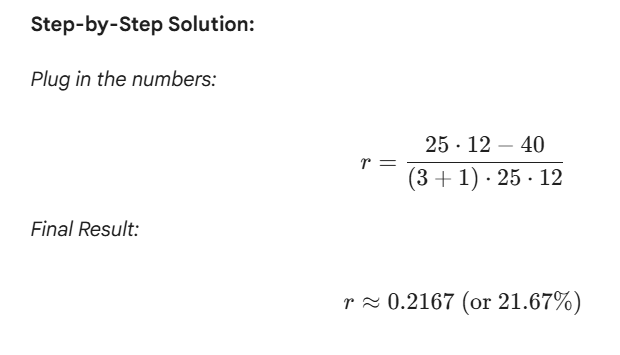
In this scenario, the highest revenue share that can be offered is 21.67% to maintain the 300% return on customer acquisition cost. If your sports business decides to do a revenue share deal, it is crucial to run the numbers so every party involved gets a good deal.
By subscribing you agree to our Privacy Policy.
Share this article